New Electric Induction Line With Creative Mini Magic Pen Children's Toy Draw Rail Car
A mini car with an optical sensor that follows a line you draw with a pen. Design the track, the car reads it — and the road changes every time the paper does.

By Usama Noman
· 6 min read · How we research & rate
Researched from the listing, buyer reviews and videos — not lab-tested.
If you buy through our links, we may earn a small commission. It doesn't change our verdict. How affiliate links work
Expert review
“A Toy Car That Drives Along A Line You Just Drew”
So… what's this thing?
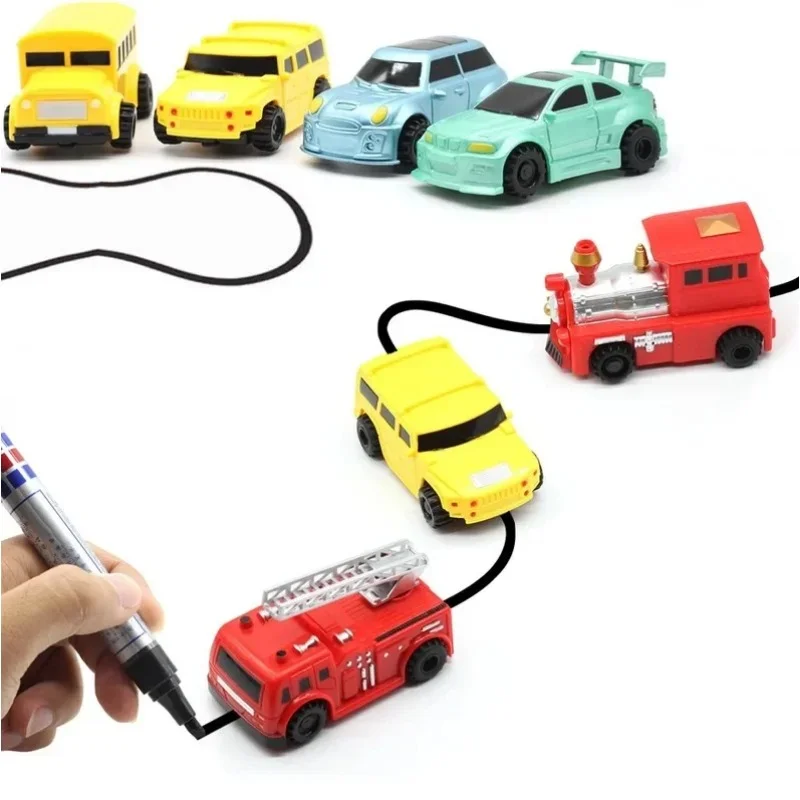
It's a motorised car that follows a line your pen just drew.
New Electric Induction Line With Creative Mini Magic Pen Children's Toy Draw Rail Car comes from Shop1103976088 Store at $10.69, down from a listed $33.56.
What makes it unusual is that it hands the track over to the child. Almost every toy vehicle on the market ships with its own course, and once it has been driven for an afternoon that course is memorised. A pen-drawn line means the toy can't be exhausted, because the moment boredom arrives the answer is another sheet of paper and a new road. The machine is following instructions a person wrote in ink five seconds earlier, and that's the small, clever idea at the centre of the whole thing.
The listing shows 21 units sold with a 86.4% rating, which is a healthy signal.
There's something quietly funny about watching it work. The car never looks where it's going. It stares at the floor directly beneath itself and lurches left and right, permanently correcting the last few millimetres, and yet it arrives. It's the least confident-looking vehicle imaginable and it never once needs to think about the destination.

How does it actually work?
Underneath the plastic is a familiar idea. an optical sensor underneath reads the contrast between a dark drawn line and the pale surface, and a small controller steers the wheels to keep that line under the middle of the car
Line-following is one of the oldest robot behaviours there's, and it's older than it looks. An optical sensor looks down at the floor and reports how much light is bouncing back. A black line absorbs most of it; the pale table reflects it. Two sensors, one either side of the line, is all the steering needed: both sensors on the white means go straight, the left sensor on the black means steer left, the right one on the black means steer right. The controller does that comparison dozens of times a second, so the car never plans a route, it just keeps correcting a mistake it's permanently about to make. The magic, and the reason this version is worth a second look, is that the line is drawn with a pen. The track isn't a printed sheet or a fixed loop. It's whatever you invent on the table, which turns a fixed toy into a craft project with a moving part.
The catch is the surface. Contrast is everything, so a marker line on a pale table works and the same line under a warm lamp on a wooden table sometimes doesn't, because the sensor can't tell the line from the grain. Squared corners are the second limitation, since the steering corrections are small and a right angle asks the car to turn further than a two-sensor correction can manage in one gulp, which is why drawn tracks work better as long curves and lazy bends than as strict gridlines. There's no published battery type, sensor sensitivity or speed here, so the behaviour you get is the behaviour the seller shipped.
Why would anyone make this?
Because the most interesting thing about a toy car isn't the car, it's who gets to design the road
Toy vehicles have a strange problem, which is that the most creative part of owning one, building the route, is usually the part the manufacturer has already done. The track is printed, the loop is fixed, and after a few runs the child has seen everything the toy will ever do. Handing over the pen flips the whole exchange. The child designs the course, the car is the thing that has to cope, and every new drawing is a fresh test with a genuinely uncertain outcome. There's a second, less obvious benefit: the toy is suddenly quiet in the way that matters, because the interesting work happens on the paper rather than on a screen. The car is a motorised pencil-holder, and the child is the engineer, and for a toy priced like an afternoon’s entertainment that's an unusually large amount of job to hand over.
Who should buy this?
Good fit:
- Children who like drawing and building their own tracks
- Parents looking for a toy that's not a screen
- STEM-toy fans who enjoy a simple robot behaviour
- Classroom and club activities that need a cheap demo
Not for you if you want a fast radio-controlled car. This is a slow, careful line-follower, not a racer, and it stops being interesting the moment the floor stops being bright.
It's also a poor fit for a child who wants a toy to do the work. This car is only as entertaining as the track underneath it, so the child who refuses to draw will be bored in five minutes, and the child who loves to draw will use it for weeks.

What's the catch?
The catch isn't a dealbreaker, but it's real.
- Surface and lighting decide everything. A pale, smooth, evenly lit table shows the line best. Dark wood, shiny glass and dim lamps confuse the sensor.
- Gentle curves beat sharp corners. The steering corrects a little at a time, so a hard right angle usually overshoots.
- Pen refills are part of ownership. The line is the track and the track wears out, so this is a toy with a small, cheerful consumable.
- No published detail. Battery type, speed and sensor range are all unstated, so nothing here's a promise.
The price is small, the concept is genuinely good and the failure modes are all fixable with better paper. Draw on a pale, flat, well-lit sheet, keep the bends gentle, and you've a toy that turns drawing into steering. That's a bargain at the cost of an afternoon snack.
The Good and the Weird
The Good
- You draw the track, so the toy never runs out of courses
- A real, simple robot behaviour a child can watch and understand
- Cheap enough to try as a stocking-sized gift
- No screen and no app involved
The Weird
- Sensor depends on a pale, flat, well-lit surface
- Sharp corners usually confuse the steering
- The line is a consumable, so pens get used up
Weirdness Meter
Usefulness Meter
Our verdict
Verdict: Fun Gift
“A clever, cheap little robot that hands the track design to the child. Keep the surface pale and the corners gentle and it's a genuinely replayable toy.”
Usama Noman
Community ratings
How weird and useful is it to you?
0 votes
Weirdness: No votes yet
Usefulness: No votes yet
Where to get it
New Electric Induction Line With Creative Mini Magic Pen Children's Toy Draw Rail Car
- Sold by
- Online store
- Price
- $10.69
Price as of . Prices change — check the store for the current price.
We may earn a small commission. How this works
Questions people ask
A sensor underneath compares the dark line with the pale surface and steers to keep the line in the middle. It sells for $10.69 and shows 21 units sold.
A clear dark mark on a pale, smooth, evenly lit surface reads best. Thick, high-contrast lines and gentle curves work far better than faint marks and sharp corners.
No. That's the point of this version: you draw the track yourself, so every sheet of paper is a new course.