AI or Lie Guessing Game
A fast party game turns bizarre AI stories into a true-or-false showdown for two or more players.
By Maya Okafor
· 5 min read
If you buy through our links, we may earn a small commission. It doesn't change our verdict. How affiliate links work
Expert review
“Can Your Friends Tell Real AI Stories From Total Hallucinations?”
So… what is this thing?
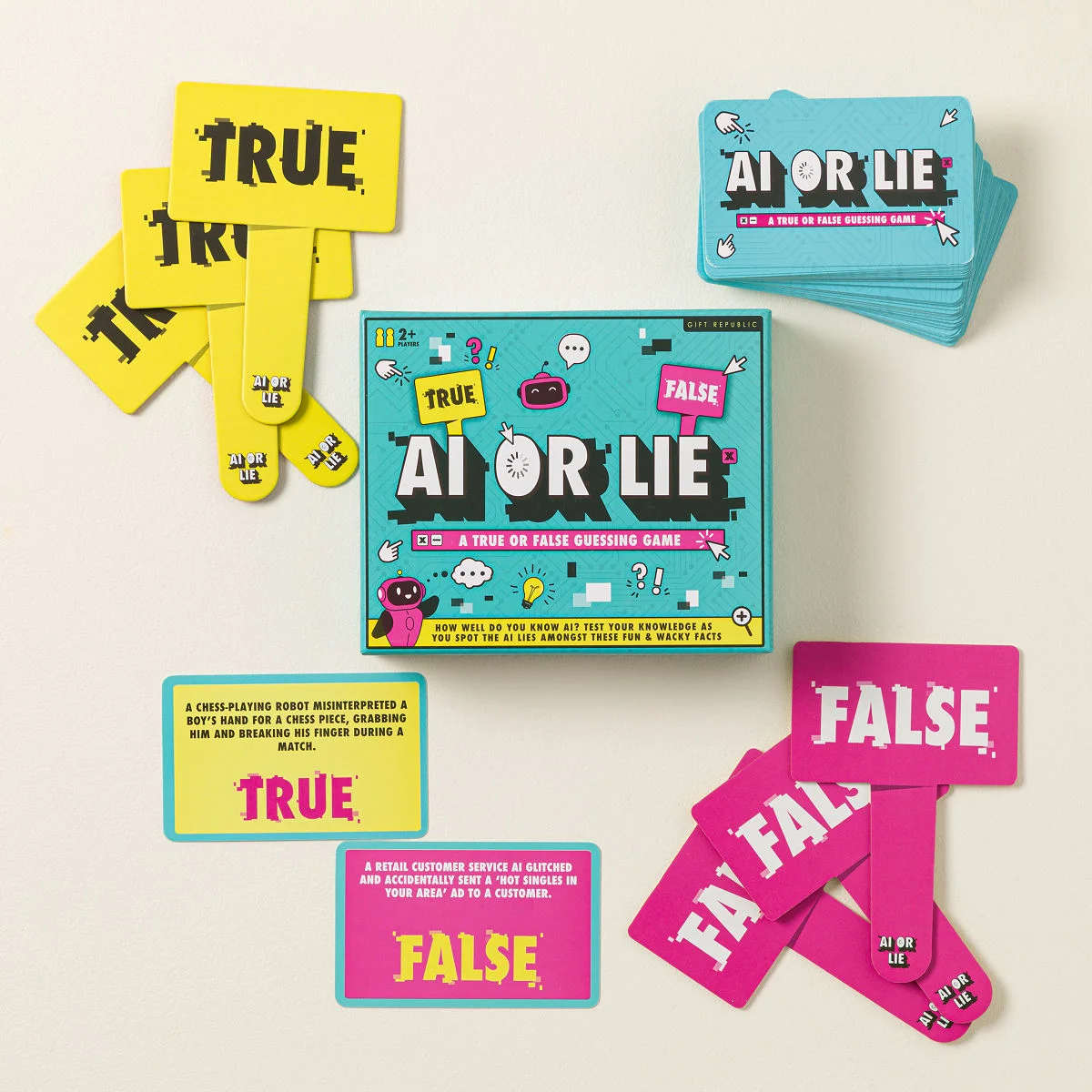
It's a party game about deciding whether an AI story really happened. AI or Lie Guessing Game gives teams a stack of strange, technology-themed statements and asks them to separate fact from fiction. Did a married man really propose to a flirty chatbot? Did an AI vacuum map a home and then post it online? You make the call.
The weirdness is built into the subject matter. This isn't a quiz about capitals or famous paintings. It's a group argument about the increasingly thin line between “that sounds impossible” and “someone definitely made a machine do that.” The stories are designed to make you doubt your instincts, which is a bold way to spend an evening with friends.
Uncommon Goods lists it at $19 for two or more players, with 106 trivia cards and instructions. Rounds take 10 minutes or more, so you can play one quick game or keep going until everyone is suspicious of every sentence in the room.
How does it actually work?
The format is simple enough to explain before anyone reaches for a snack. Teams take turns reading a statement about artificial intelligence. The other players decide whether it is true or whether it is an invented AI-related lie. Correct guesses earn points, and the team with the highest score wins.
The box includes 106 trivia cards and instructions. The cards supply the material, so nobody has to prepare a presentation or become the group's resident technology expert. The game is for two or more players, and Uncommon Goods lists it for ages 12 and up.
The listed play time is 10-minute-plus rounds. That makes it flexible: you can use it as a quick opener at a gathering, then put it away, or turn it into a longer competition. The central mechanic is guessing, not building a board or learning a complicated card economy. You listen, make a snap judgement, and discover whether your confidence was earned or merely loud.
The box is made from paper and measures about 13 inches long by 1.4 inches wide by 3.7 inches high. Care is simply wiping it with a cloth, which is useful information if the game night snacks get ambitious.
Why does this exist?
Because AI has become a perfect source of social confusion. Everyone has heard a story that sounds too strange to be real, and everyone has also seen a computer confidently say something that isn't true. This game turns that shared uncertainty into a competition.
It also gives a familiar party format a fresh topic. True-or-false games are easy to join because the rules are intuitive. The AI angle makes the content feel current and gives each card a little extra mischief. You aren't just trying to remember facts; you're trying to judge whether a fact is plausible in a world where software can write, draw, talk and occasionally make a spectacular mess.
The game exists for the moment after someone says, “No way.” Instead of ending the conversation there, you can make it the next round. That is a strong design choice for a social product: the argument is not a problem. It is the entertainment.
Who on earth needs this?
Good fit:
- Tech-curious families with players old enough for the 12+ recommendation.
- Office parties and dinner groups that want a quick activity without a full board-game setup.
- People who enjoy surprising facts, especially when the first reaction is “surely not.”
- Gift buyers who want something topical, inexpensive and easy to explain.
Not for you if you want a strategy game with lots of pieces, a quiet solo activity, or a subject completely free of technology talk. The game depends on conversation and quick judgement. If your group hates being wrong in public, the room may become very quiet very fast.
There are no customer reviews on the listing yet, so there aren't buyer reports about the balance of the cards or the quality of the discussions. The structure is clear enough, though: a compact, team-friendly true-or-false game built around bizarre AI stories.

The practical catch
The game's biggest strength is also its shelf life question. AI stories change quickly. A card that feels astonishing now may feel familiar later, while a story that sounds ridiculous today might become ordinary next year. The fun depends on the group finding the statements surprising enough to debate.
The 106-card count gives the box plenty of material, but the listing doesn't promise a replay system beyond working through the cards again. That makes it best for gatherings where the conversation matters as much as the score. People may remember the arguments long after they remember who won.
The age recommendation is 12 and up, and the game is designed for at least two players, so it isn't a preschool activity or a solo puzzle. It also uses a subject that can invite side conversations about technology, truth and online nonsense. That is a bonus for curious groups and a possible detour for people who wanted a completely brain-off game night.
At $19, it is a relatively low-risk way to add a new prompt to a party. Just be prepared for the final challenge: convincing everyone that your most confident answer was not itself generated by AI.
The Good and the Weird
The Good
- Simple true-or-false rules
- 106 cards provide lots of prompts
- Works for two or more players
- Affordable, conversation-starting gift
The Weird
- Depends on a group enjoying debate
- AI topics may age quickly
- Not a solo or strategy game
- No customer reviews yet
Weirdness Meter
Usefulness Meter
Our verdict
Verdict: Fun Gift
“A timely party game with a wonderfully unstable subject. It won't teach you to detect every AI lie, but it should make your group argue cheerfully about the weird ones.”
Maya Okafor
Community ratings
How weird and useful is it to you?
0 votes
Weirdness: No votes yet
Usefulness: No votes yet
Where to get it
AI or Lie Guessing Game
by Uncommon Goods
- Sold by
- Online store
- Price
- $19.00
Price as of . Prices change — check the store for the current price.
We may earn a small commission. How this works
Questions people ask
The game is designed for two or more players, with teams taking turns reading statements and guessing.
It includes 106 trivia cards and instructions.
Uncommon Goods lists it for ages 12 and up.
The listed approximate play time is 10 minutes or more per round.